Catering Discovery Questions: What to Ask Before You Build the Proposal
Discovery is the bridge between an inquiry and a proposal. The questions that actually matter, and how they change by event type.
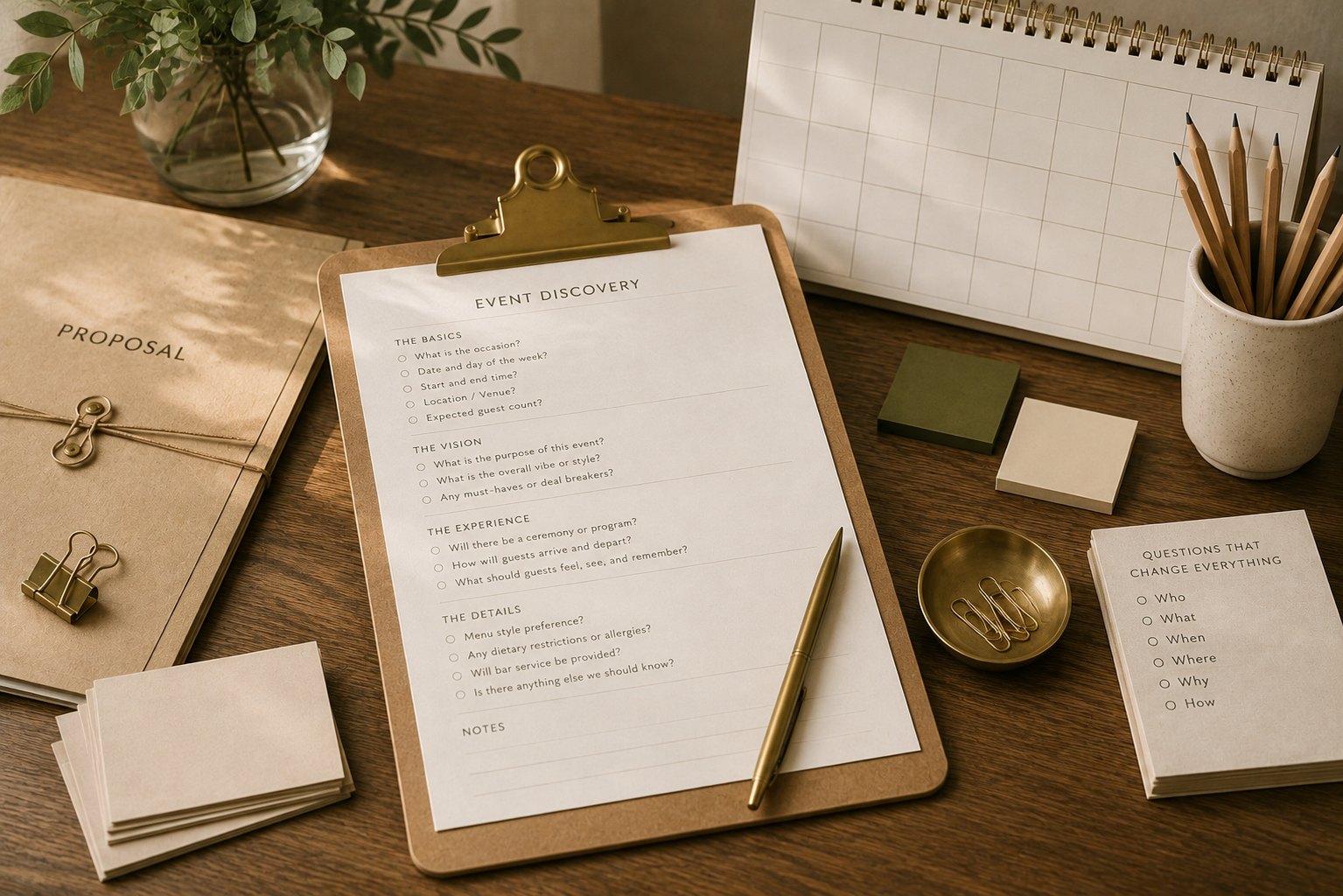
A lead comes in: "I'm planning an event for about 100 people in October. Can you send pricing?" Technically, you could send something. You have a headcount and a month. But you cannot yet recommend the right experience, and anything you quote is a guess dressed up as a proposal. The gap between that inquiry and a proposal worth signing is discovery. It is the conversation where you learn enough about the event to build for it, not around it.
Good discovery is not a longer intake form. It is knowing which questions matter for this event, asking them in the right order, and listening for what the answers really mean. This guide walks through the questions that apply to almost any event, then how they should change depending on whether you are catering a board dinner, a wedding, a fundraiser, or a three-day conference.
Have an inquiry in front of you? The Client Discovery Question Generator builds a question list based on the event type, guest count, service style, venue, and scope, so you walk into the call knowing exactly what to ask.
Build My Discovery Questions →What client discovery actually is
Discovery is often confused with data collection: date, guest count, venue, menu. Those are the easy facts, and they are necessary, but they are not discovery. Strong discovery uncovers the things that shape the whole event: why it is happening, what the client cares about most, what the guests expect, what constraints the venue and budget impose, who makes the decision, and what success looks like to the person in front of you. The difference is the difference between taking an order and understanding an event. One gets you a quote. The other gets you a proposal that feels like it was written for them, because it was.
The questions that matter for almost every event
Before any event-specific branch, there is a foundation that applies nearly everywhere. If you can answer these, you can start building. If you cannot, you are guessing.
- What is the event, and why is it happening?
- Who is attending, and how many?
- Where is it, and is the venue confirmed?
- What is the timing: start, end, and when food is served?
- What experience does the client want guests to have?
- What services are needed, from food only to the full event?
- What matters most to them, and where are they flexible?
- Who makes the decision, and who approves the spend?
- What is the budget context?
- What happens next, and by when?
That list is the foundation, not the whole conversation. Where discovery gets valuable, and where newer salespeople tend to stall, is knowing which questions to add on top once you know what kind of event this is.
Why discovery should change by event type
The same caterer, on the same day, should run very different conversations depending on the event. A wedding couple often cares most about guest experience, personalization, dinner pacing, the bar, the tabletop, and family expectations. A corporate planner is usually thinking about the agenda, meal timing, executive expectations, dietary inclusion, reliability, procurement, and billing. A nonprofit gala tends to revolve around the program, sponsors, donors, auction flow, and a fundraising goal that the food has to support without upstaging. Ask a corporate planner about their vision for guest experience and you will get a polite non-answer. Ask a wedding couple about their PO process and you will lose the room. Matching the questions to the event is most of the skill.
Corporate catering discovery questions
Corporate work rewards precision and reliability. The event serves a business purpose, runs to a schedule, and often has to clear internal approvals and billing rules before it can move. Get the purpose and the audience first, because a client-facing event and an internal team lunch are different products even at the same headcount.
- Is the audience mainly employees, clients, leadership, or a mix?
- Is there an agenda we should build food service around?
- Will everyone break for the meal at the same time?
- Are there executives, speakers, or VIPs needing special consideration?
- Are there PO, vendor registration, or invoicing requirements?
- Who approves the menu, and who approves the final spend?
- Is this a one-time event or part of a recurring program?
For a board or executive meeting, lean into discretion, timing, premium presentation, and quiet, efficient service that does not interrupt the room. For a large employee appreciation event, the conversation shifts to guest flow, scale, dietary inclusion, and engagement, because those are what make or break the experience once you cross a few hundred people.
Wedding catering discovery questions
Wedding discovery has to hold two things at once: it is deeply personal, and it is a complex operation. Lead with the couple's priorities before you suggest a single upgrade. A couple who values guest experience will define a great reception very differently from one focused on menu variety or visual presentation, and if you pitch before you understand that, you are selling past them.
- Which parts of the food and beverage experience matter most to you two?
- Are the ceremony and reception at the same venue, and what happens in between?
- Is a planner or coordinator involved, and who owns the master timeline?
- Who besides the couple is part of catering decisions?
- Are there family traditions, cultural elements, or meaningful foods to reflect?
- Will vendors need meals, and are children's meals needed?
- Are you considering late-night food, and are there other weekend events?
The operational questions matter just as much, but they land better once the couple feels understood. Vendor meals, children's meals, cake handling, and late-night bites are easy to miss and easy to price once surfaced. And a single wedding inquiry often hides a welcome party, a rehearsal dinner, and a farewell brunch, so it is worth asking whether other weekend events may need catering too.
Social event discovery questions
Social events vary more than any other category, which is exactly why a generic checklist fails them. A baby shower, a milestone birthday, a graduation, an anniversary, a holiday gathering, and a celebration of life are all social events, and almost nothing about them is the same. The occasion changes the tone, the service expectations, the timeline, the menu, and how hands-on the host wants to be.
So start with the occasion and the host's vision, then let the format drive the logistics: is this a seated meal, a party, a cocktail event, or open-house style? For a shower, pin the meal period and any games or gift-opening that affect the timeline. For a milestone birthday, ask about surprises and reveals that change setup timing. For a celebration of life, change your whole posture: keep discovery brief and warm, prioritize ease for the host, dependable timing, generous holding for guests who arrive over a window, and inclusive food. That is not the moment for upsells or playful language.
Nonprofit and fundraiser discovery questions
At a fundraiser, the food is rarely the point, and knowing its role is the first question. Sometimes it needs to stay in the background of the program; sometimes it carries the night as a featured part of the guest experience. That single decision drives the entire plan, from service style to staffing to pacing.
- Is the food supporting the program, or a featured part of the experience?
- Is there a seated program, auction, awards presentation, or fundraising appeal?
- Are there sponsor commitments affecting food, beverage, signage, or service?
- Are there different ticket or donor levels with different experiences?
- Are any catering services, beverages, or products being donated?
- Are there key donors, honorees, or VIPs needing special consideration?
The program dictates service timing more than anything else here. Courses, coffee, and clear-down all have to work around the moment on stage. And watch for donated wine or product, tiered donor experiences, and sponsor obligations, because each one quietly changes your scope, your floor plan, or your liability.
Conference and multi-day discovery questions
Multi-day events break the one-number habit. A single guest count is almost never enough, because attendance shifts by day and by meal, and the difference between a full breakfast and a light one across three days is real money in both directions. Map every service occasion before you price anything.
- Does attendance change by day or by meal period?
- Which meals and breaks require catering across the schedule?
- Are all attendees released at once, or are there concurrent breakouts?
- Will exhibitors, speakers, staff, or volunteers need separate meals?
- How will dietary needs be collected and communicated to us?
- Are any meals in different rooms or buildings, and is overnight storage available?
Back-of-house and green-room meals are easy to overlook and add real count. Dietary tracking at scale needs an agreed system, not a note on the night. And multiple rooms or buildings multiply transport, holding, and staffing in ways a single-room event never hits, so it is worth confirming early.
Ask the questions that change the proposal first
Not every question belongs in the first conversation. The most useful framework in catering sales is to separate questions that change the proposal from questions that only refine execution. Ask the first group early; the second group can wait.
- Ask before the proposal: guest count, venue, service style, meal period, scope, and budget context.
- Confirm later: exact linen color, final entree indicators, detailed load-in timing, and place-setting details.
Anything that moves the price, the scope, the feasibility, or reveals the client's priorities is a first-conversation question. Everything else can be gathered as the event firms up. Trying to resolve every operational detail on the first call is how discovery starts to feel like an interrogation, which is the fastest way to make a client go quiet.
How to talk about budget
Budget does not have to be adversarial, and "what's your budget?" is rarely the best opening. It puts clients on the defensive and often gets you a number that reflects what they think they should say, not what they would actually spend for the right experience. Instead, try to understand the target investment, the priorities, the must-haves, and the areas open to adjustment.
- "Have you established a target range for catering and beverage?"
- "Which elements of the event are most important to protect if we need to adjust?"
- "Are there areas where you'd prefer to invest more heavily?"
Those questions give you more usable information than a single maximum ever will. They tell you where to spend, where there is room to trim, and how to make any value engineering feel collaborative rather than like a downgrade. When you do need to run the numbers behind the conversation, the pricing and staffing tools take it from there.
Listen for the question behind the answer
Discovery is consultative selling, which means the words a client uses are a starting point, not a spec. When someone says "we want it casual," do not quietly translate that to inexpensive. Casual can mean the food, the service style, the presentation, the atmosphere, the budget, or a little of everything. Clarify it: "Casual in terms of the menu, the service, the presentation, the atmosphere, or all of the above?"
The same goes for simple, elegant, fun, elevated, easy, interactive, budget-friendly, and not too formal. Each one means very different things to different clients, and building a proposal on your interpretation instead of theirs is how you end up revising it three times.
“The client tells you what they want in their words. Your job is to find out what those words mean before you price them.”
Don't turn discovery into an interrogation
A question list is a guide, not a script to read top to bottom. The best discovery sessions feel like a conversation. Listen for answers that quietly resolve later questions, skip the ones that clearly do not apply, and follow up when something important surfaces. When a client does not know an answer, that is fine: flag it for follow-up rather than forcing a decision on the spot. Not everything has to be resolved on the first call, and pretending it does only makes the client feel cornered.
Turn discovery into a clear next step
A strong discovery conversation should move the opportunity forward, not just fill in a form. Before you hang up, you should be able to summarize what is confirmed, what the client values most, what is still unknown, what affects the proposal, and what happens next, with a clear owner for that next action.
- Confirmed details and the client's stated priorities
- Outstanding questions and anything flagged for follow-up
- The next step: proposal, menu development, venue walkthrough, rental quote, tasting, or an internal feasibility check
- Who owns that next step, and by when
That summary is also the backbone of a proposal that lands. When the client reads it back, it should feel like you were listening, because the whole point of discovery is that you were.
Build your discovery guide
Every event needs a slightly different conversation. Instead of working from the same checklist every time, build a guide around the event in front of you: the type, the guest count, the service style, the venue, and the scope. It tells you what to ask first, what refines the proposal, and what can wait, with a short note on why each question matters.
Working an inquiry right now? The Client Discovery Question Generator turns what you already know into a prioritized, event-specific set of questions you can use before or during the call.
Open the Discovery Question Generator →Finish the job
Client Discovery Question Generator
Know what to ask next. Build an event-specific discovery guide before the call.
Keep going, related on Click to Table